
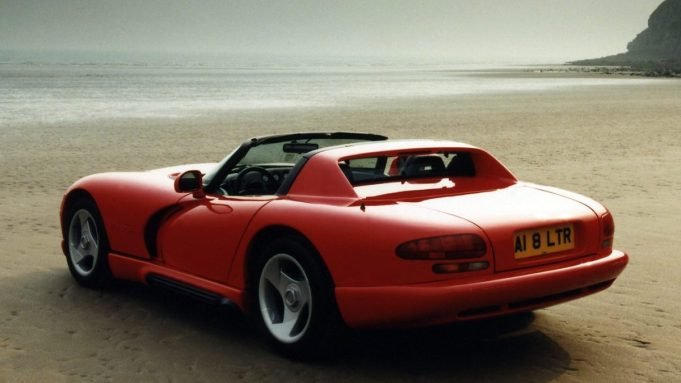
### **The Viper’s Legacy: A Symphony of Power and Design**
In the lavish realm of automotive excellence, the Dodge Viper emerges as a legendary figure, its legacy intertwined with the very heartbeat of American performance. By the dawn of the 21st century, it had undergone a series of refinements, yet there lingered whispers of a need for rejuvenation—challenges replacing the whimsical charm of its earlier days with the pragmatic demands of a new era. DaimlerChrysler, the harmonious fusion of American muscle and German engineering birthed from a momentous merger, recognized the imperative to breathe new life into this automotive icon.
So, on a captivating day in Detroit, a mere eleven years after the initial conceptual debut of the Viper, the world was introduced to the audacious GTS/R coupe concept. Its wild, winged silhouette was a prophet of daring adventures yet to come. A year later, the production version burst onto the scene, unveiling itself as a mesmerizing droptop, ready to conquer the winding roads and sun-kissed highways of 2002.
The evolution of the Viper’s design signaled a shift in artistic direction—trading the gentle, flowing curves of yore for a more assertive demeanor punctuated by sharp angles, each line telling a story of bold ambition. Yet, amidst this striking visual overhaul, the unmistakable proportions remained: a gargantuan engine nestled behind the cockpit, an embodiment of fierce power cradled within a sculpted machine. The reborn SRT-10, an homage to Dodge’s Street & Racing Technology division, introduced a refined convertible experience—now equipped with a proper folding soft top, instead of the beguiling simplicity of its predecessor’s canvas cover.
Power, the soul of this beast, took center stage as the second-generation Viper boasted a formidable 8.3-liter V-10 engine. With the heart pulsing at an exhilarating 500 horsepower and a staggering 525 lb-ft of torque, the thrill was palpable—each press of the pedal resonated with an undeniable crescendo of automotive delight. The coupe, arriving with heightened ambition, offered a tantalizing 10 additional horses and lb-ft, an invitation to experience speed in its most luxurious form, tethered to a seamless six-speed manual transmission that delivered raw power to the rear wheels.
As the years unfurled, a midlife reimagining in 2007 saw the Viper emerge even more formidable. The engine swelled to a titanic 8.4 liters, ushering in a new era of performance with a formidable 600 horsepower and 560 lb-ft of torque. Enter the ACR version—a symphonic blend of precision and power, expertly crafted to dance alongside the revered Porsche 911 GT models on the racetrack. While its V-10 engine held steady, an ensemble of lightweight materials and aerodynamic enhancements transformed the Viper into a formidable contender, ready to carve its legacy into the annals of automotive history.
Yet, despite its resplendent capabilities, the second-generation Viper finds itself in a delicate balance of legacy, merely forward in progression. As the trilogy unfolds—the first generation boldly planted the Viper flag in the world of supercars while the third redefined its stature—the second iteration reverently continued the tradition without transcending its predecessor’s formidable shadow. In this competitive arena, it holds a distinguished bronze—not a lesser achievement, but rather a testament to the unwavering spirit of the Viper, a timeless icon for those who seek the extraordinary.