
The Dawn of AI-Driven Hotel Discovery: Elevating Visibility in a Transforming Landscape
In the resplendent realm of luxury travel, where every moment is crafted for opulence and refinement, the quest for the ideal accommodation is undergoing a remarkable metamorphosis. As travelers increasingly forsake traditional search engines, they are instead embracing the intelligent guidance of AI-powered assistants like ChatGPT and Google’s AI Mode. This profound shift not only streamlines the hotel search process but also heralds the emergence of a new paradigm: the concept of "AI hotel visibility," a metric that is rapidly becoming indispensable for the hospitality industry.
Finding hotels has evolved from a laborious endeavor of scrolling through endless lists to a succinct exchange of inquiries. Picture this: a traveler, weary from planning yet still brimming with anticipation, simply asks an AI assistant for recommendations—“What are the best family hotels in Mallorca?” The assistant promptly curates a select roster of four or five choices, and in this simplified process, most users feel inclined to cease their search, entrusting their decision to the distilled wisdom of the AI.
The framework of AI recommendations is built upon two pivotal concepts: mentions and citations.
- Mentions represent the hotels explicitly articulated in an AI’s response, a direct nod to the desired destination for discerning travelers undertaking their journeys.
- Citations, on the other hand, reflect the sources from which these recommendations are derived, guiding users towards verified information.
Within the intricate tapestry of this study, conducted with precision by Tharro, an analysis of 695 unbranded hotel inquiries spanning the sun-drenched shores of the Algarve, the idyllic landscapes of Mallorca, and the historic allure of Rhodes, reveals fascinating insights. Framed as queries reflective of genuine traveler intent, searches were orchestrated through both ChatGPT and Google’s AI Mode, followed by meticulous comparisons to an astonishing 293,925 ranked results from Google and Bing. The outcome? A veritable treasure trove of nearly 10,000 hotel recommendations, encompassing 3,626 distinctly named establishments across an expansive array of 1,604 domains.
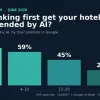
Yet, does a prestigious Google ranking guarantee mention in the AI’s selective embrace? While a commendable ranking does elevate the chances of being included in AI recommendations, it is far from an assurance. For instance, a hotel positioned among the top three results is acknowledged by AI approximately 66% of the time, while that figure dips to a mere 27% for hotels languishing beyond the twentieth position. Remarkably, an astonishing 48 to 56% of hotels favored by AI failed to grace Google’s organic listings for analogous searches. In Albufeira, a mere duo of hotels identified in Google’s first pages was recognized by AI, underscoring the significant potential for hidden gems to shine in this new digital constellation.
But the intrigue deepens: the relationship between mentions and citations unveils an unexpected reality. Despite their high Google ranking, many hotels discover that their own websites are rarely referenced as sources in AI recommendations. Shockingly, less than 10% of citations stem from a hotel’s domain, with third-party entities such as online travel agencies, review platforms, and editorial guides prevailing as the favored sources for AI. This denotes a striking dependency on intermediarial platforms, inviting hotels to transcend reliance on their own narrative in bolstering visibility.
Diving deeper into the contrasting methodologies of the AI engines, ChatGPT and Google’s AI Mode, one observes their distinctive tendencies. ChatGPT’s recommendations embraced 3,151 unique hotels, while the Maps-centric approach of Google’s AI Mode yielded 1,286 names, with barely 18% of the hotels featuring on both lists. Each system curates its own collection of amenities and attributes, transforming the process of discovery from a mere algorithmic calculation into an editorial journey.
Breaking down the factors that sway AI recommendations, a surprising revelation emerges: guest ratings, traditionally viewed as a cornerstone of excellence, do not reign supreme. Instead, review volume coupled with star classification prominently shapes AI’s choices, revealing a preference for established luxury hotels with ample guest testimonials, even if their individual scores are moderate. In this nuanced environment, hotels that focus on accumulating a robust body of reviews across diverse platforms hold a distinct advantage.
To enhance AI hotel visibility, the study outlines essential strategies for hotels poised to captivate AI recommendations:
-
Measure AI visibility distinct from SEO: Utilize AI platforms to ascertain whether your hotel appears in their curated lists for vital searches.
-
Optimize presence on third-party platforms: Craft accurate and comprehensive profiles on online travel agencies, review sites, and editorial platforms, as these are regularly cited by AI.
-
Boost review volume: Create compelling avenues for guests to articulate their experiences, as the weight of numerous reviews trumps singular high ratings.
-
Treat each AI engine as a unique channel: Appreciate the divergent criteria employed by ChatGPT and Google’s AI Mode, aligning strategies accordingly.
- Eschew over-reliance on your own website: Recognize that the digital world favors visibility through intermediaries rather than self-representation alone.
In conclusion, this research elucidates the widening chasm between conventional search hierarchies and the burgeoning potential of AI-generated hotel suggestions. By prioritizing factors such as review volume and star rating, as well as optimizing for third-party platforms, hotels can effectively navigate this new stratosphere of visibility. As the landscape of travel search continues its evolutionary march, embracing the artistry of AI will undeniably craft a pathway toward a more prosperous and connected experience for travelers and hoteliers alike.