
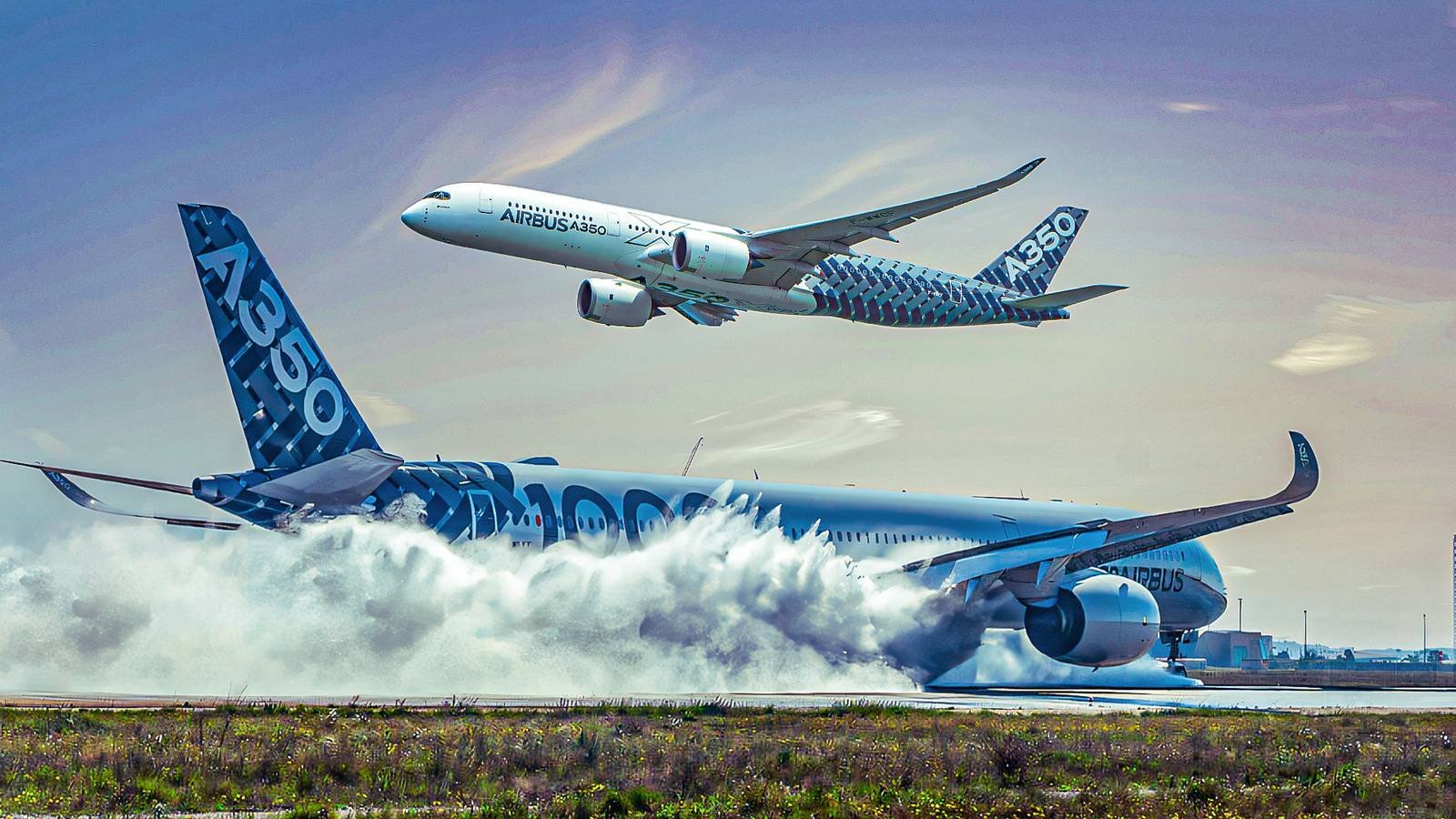
The Ambitious Elegance of the Airbus A350: A Journey into the Extra Wide Body Realm
In the ever-evolving landscape of aviation artistry, the Airbus A350 stands as a monumental achievement, swiftly ascending to the zenith of desirability among discerning carriers. This sophisticated aircraft, celebrated for its sleek design and impressive engineering, is rapidly carving a niche for itself as one of the best-selling aircraft in contemporary aviation history.
The A350’s genesis is a tale steeped in innovation, inspired in part by its illustrious predecessor, the Dreamliner. Each model exudes an aura of grandeur, distinguished by its cutting-edge technology, yet each comes at a steep price. The A350 is priced from an estimated $308 million for the smaller variant to upwards of $366 million for the stretched A350-1000—a $50 million margin underscoring the profound engineering complexity behind its grandiose stature. Such figures, while daunting, merely hint at the elevated experiences hidden behind these luxurious facades.
Beyond the eye-catching figures and state-of-the-art advancements, lies the narrative of the A350-1000. This larger variant boasts nearly 20 percent more seating capacity, designed explicitly for high-density routes replete with premium clientele. It embodies a symbiotic balance between aesthetic beauty and functional prowess, accommodating around 480 passengers in a high-density configuration, a stark contrast to its smaller sibling.
Two Sides of the Same Airframe
As one gazes at the elegant silhouette of the A350, it becomes evident that both models share a remarkable duality, yet each is infused with its unique character. While the A350-900 serves as a gracious workhorse for long-distance routes with moderate demand, the A350-1000 is unapologetically lavish in its ambition, engineered for routes that require not just capacity but also uncompromising luxury.
One cannot overlook the palpable intricacies that differentiate the two. Both aircraft sport identical wingspans, yet the A350-1000’s wing has been meticulously designed with distinct aerodynamic features to enhance lift and improve fuel efficiency. These intentional adaptations, while subtle, contribute to the complexity and allure of operating such a sophisticated machine.
A Powerful Duality
The heart of the A350 beats vigorously with the Rolls-Royce Trent XWB engine family, a pinnacle of engineering excellence. The A350-1000 embraces the power of the Trent XWB-97 variant, delivering a remarkable thrust of 97,000 pounds, a crescendo in performance that harmonizes with its imposing frame. In contrast, the A350-900, though formidable in its own right, utilizes the slightly less powerful Trent XWB-84, exhibiting a thrust of 84,000 pounds. This nuanced differentiation is vital, enabling both aircraft to harmonize elegance and efficiency across their respective operating profiles.
Airlines view the additional weight and cost of the A350-1000 as a strategic investment, reaping higher profits per flight due to its enhanced capacity and reduced seat-mile costs. Such decisions inspire admiration for the performance-oriented calculus that governs modern aviation.
The Same, Yet Different
While the architectural beauty of the A350-1000 is visually arresting, its engineering intricacies speak to a higher narrative of sophisticated craftsmanship. Employing a blend of Carbon Fiber Reinforced Polymer allows both variants to maintain structural integrity while losing weight—a luxurious dichotomy in the world of aviation design. The A350-1000’s fuselage extends dramatically over its smaller counterpart, necessitating intricate enhancements around high-stress areas to ensure reliability and safety in every flight.
One cannot underestimate the meticulous designs that underpin each joint and connection, especially where the robust six-wheel landing gear interfaces with the crafted wing. Unique hybrid architectures blend titanium with composite materials, a forward-thinking approach that distributes weight and stress effectively, attesting to Airbus’s commitment to marrying durability with elegance.
A Vision for the Future
As Airbus embarks upon a new chapter with the introduction of ultra-long-range variants like the A350-1000ULR, the horizon of commercial aviation expands. With a promise to engage in non-stop flights transcending continents, Qantas’s Project Sunrise encapsulates the next frontier in luxury air travel. These endeavors not only signify growth for aviation but also promise experiences that redefine the passenger journey.
A sumptuous realm awaits passengers aboard the A350, from opulent First Class suites to immersive Wellbeing Zones, designed intricately to support utmost comfort during lengthy cross-continental travels. The marriage of performance with luxurious refinement paves the way for a transformative approach to global connectivity—that is simply beyond compare.
Thus, as we peer into the future of aviation, the monolithic presence of the A350 inspires awe and invites us to dream of endless horizons, echoing the ambitious spirit of the United Arab Emirates—where luxury knows no bounds.