
Title: "The Paradox of Progress: U.S. Manufacturing’s Jobless Boom"
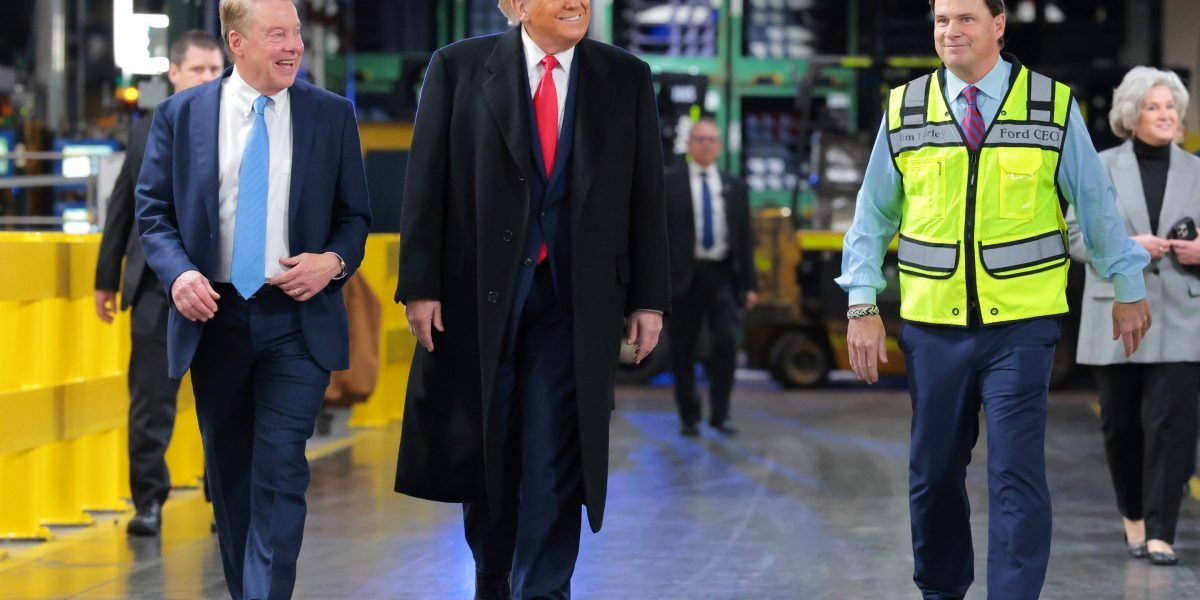
In a grand overture echoing through the iconic streets of Detroit, President Donald Trump emerged with a sense of jubilation that suggested an eloquent revival within the bastion of American manufacturing. Approaching the heart of the automotive realm, he proclaimed an epoch of unfettered investment—an exhilarating ascent fueled by an influx of $18 trillion in global capital, promising to elevate the economy to unprecedented heights. Yet, beneath the polished exterior of these proclamations lies a profound dissonance, one that resonates deeply through the workforce: the reality of dwindling job creation in an industry where ambition once boomed.
Standing before a crowd that represented the spirit of innovation, the President devoted nearly an hour extolling a narrative laden with optimistic hyperbole—exciting claims of soaring productivity intertwined with an almost lyrical depiction of an economy reborn. Yet, like a finely crafted automobile concealing imperfections beneath its gleaming surface, the truths of this "manufacturing revival" reveal a stark contrast. The unadorned statistics whisper a tale of regressive employment; labor data indicating a decline in manufacturing jobs—including those pivotal positions in the automotive sector—has unfolded every month since that jubilant Liberation Day.
As the President’s words painted visions of escalating prosperity, the condition of the workforce rendered silent narratives. A staggering 72,000 jobs have vanished—casualties of an environment where burgeoning investments fail to translate into meaningful employment. This paradox encapsulates the broader economic landscape of 2026—a landscape characterized by a "jobless boom," where GDP growth, projected by the Atlanta Fed to surge at an impressive 5.4% during the fourth quarter, becomes disassociated from the tangible reality of blue-collar employment.
"Manufacturing has been languishing," reflected Skanda Amarnath, the enlightened executive director of Employ America, capturing an essence that resonates with the pulse of the industry. The swirling uncertainties cast samplings of unease among manufacturers as they navigate shifting tides. The intricate dance of tariffs—an intricate layering of costs—has created a complex labyrinth where American producers find it increasingly challenging to compete favorably with the simplicity of imported alternatives.
As the threads of re-shoring weave into the fabric of industry conversations, Amarnath cautions against optimism masked in political rhetoric. He elucidates the dissonance of aspirational language versus the stark realities faced by manufacturers struggling in the present day. "In the here and now, aspirations often clash with practical limitations," he notes with a touch of pragmatic elegance.
Even as production shifts back to American soil, it arrives draped in the high-tech finery of automation, representing a new era of manufacturing that prioritizes mechanical precision over human touch. The automotive sector’s embrace of robotics is profound; the International Federation of Robotics reported that roughly a third of consumer robots find sanctuary in factories by 2024. The United States stands shoulder to shoulder with industry giants—Japan and Germany—boasting one of the highest ratios of robots to human workers in the world.
Amidst a backdrop of tightening immigration policies and generational hesitance towards blue-collar careers, an unnerving disconnect emerges. As executive leaders like Ford’s Jim Farley voice alarm over unfilled positions even at competitive wages, echoes of concern reverberate within the fabric of the nation’s economic health. Mark Zandi, chief economist at Moody’s Analytics, distills the sentiment succinctly—a future manufacturing renaissance, albeit robust, will inevitably be mechanized, devoid of the vibrant job opportunities that once characterized the industry.
In survey data, the strain emerges with clarity; the ISM Manufacturing PMI slid to a troubling 47.9, marking the tenth consecutive month of contraction. It reveals an industry ensnared by uncertainty—tariffs and a slowdown in consumer spending loom large, shadows cast by a volatile economic climate. The paradox intensifies as luxury automobile sales exhibit resilience, fueled primarily by affluent consumers, while the middle and lower echelons of society find themselves increasingly sidelined, marginalized in this strenuous equation of economic disparity.
As we journey into 2026, the horizon remains flecked with cautious optimism, poised to navigate a milder landscape of automobile manufacturing amid lower interest rates and potential tax incentives. Yet, the specter of a chasm—a "K-shaped" economy—hints at a more extensive narrative of disunion. In contemplating the greater spectrum of our economic reality, Zandi reflects on an overarching theme: "The world is de-globalizing, and the manufacturing realm must adapt or risk further decline."
Thus, the paradox of progress in U.S. manufacturing emerges vividly—a story woven with ambition yet tinged with melancholy. A world once heralded for its bountiful job creation now unfurls a narrative of transformation, where mechanization triumphs over the human touch, inviting contemplation over the essence of progress itself.